2026-09-12 06:30:44
How to choose the best Mahakal Shiva 3D Model for 3D Printing
From a collectible to a home decor piece, a Mahakal Shiva statue can take a special place in the heart of a devotee, artist, designer, or manufacturer. With 3D printing becoming an increasingly popular tool for creating custom statues, one may opt to design or purchase a personalized Mahakal Shiva 3D model and print it in their desired size, pose, and detail. However, not every digital design is a good candidate for 3D printing. To achieve the best possible result, it is important to consider certain factors before downloading a Shiva statue 3D printable file.
Know What You Want to Print
The first step to finding the best Mahakal Shiva 3D Model for printing is identifying one’s needs and expectations. A small decorative idol may have different requirements than a large-scale statue. The level of detail, technology, material, and resolution also matter.
Before looking for a desired file, one should consider the statue’s intended size, technology (resin or FDM), material, and resolution. For example, if one knows the approximate size of a printed idol, they should look for a 3D model that can be scaled up or down without loss of detail. Moreover, one should decide on the pose and the elements they want to see in their Shiva statue: a meditating or dancing Lord, an idol with a trident, a snake, a crescent moon, a damru, or other signs of Shiva’s character.
STL File for 3D Printing Shiva Statue
It is important to remember that not all 3D models are suitable for printing. One should look for a digital design that is intended for 3D printing or has been adjusted for the specific needs of a printer. In particular, a 3D model should have a clean STL file that has been carefully prepared for manufacturing. The quality of an STL file can be estimated by previewing it in a 3D slicer. The file should have a closed surface and no damaged or intersecting geometry. One should also pay attention to faces’ normals: if they are pointing inwards, the 3D model will have an incorrect surface orientation. In addition, a potential 3D printable file should not have too much detail, as it may have issues exporting or printing. On the other hand, an STL file should have enough detail to be seen at the chosen printing scale. Too few details will make the printed idol look cartoonish, while too many unnecessary polygons will increase file size and will not improve the statue’s quality.
Looking for a High-Detail Shiva 3D Model for 3D Printing
If one wants a detailed Mahakal Shiva statue, they should look for a 3D model with sufficient polygon count and resolution. Fine features on the character’s face and body, jewelry, patterns on the clothing, and other elements will be clearly seen on the printed idol. However, it is important to remember that a very detailed 3D model may be incompatible with a particular 3D printer. Extra small details may be lost due to the printer’s nozzle size or resolution. Therefore, the visual quality of a 3D model depends on the technology, size, and other factors. Both resin and FDM 3D printing technologies can be used to manufacture a detailed Mahakal Shiva statue. However, for best results, one should consider the printer’s resolution and the file’s scale. A higher level of detail will require a higher print resolution and a smaller scale.
Before downloading a 3D printable file, one should preview a potential design and take a closer look at its geometry. First of all, it is important to make sure that all parts of a 3D model are connected correctly and that there are no additional geometry issues.
Next, pay attention to the wall thickness, inside geometry, and other model features. Some 3D printable files have extra support details, while others do not have enough details for stable printing. The base is also important, as it affects the print’s final appearance and manufacturing process. An appropriately sized and stable base will reduce the risk of print failures. On the other hand, a very small base and protruding details will require extra printing supports. Moreover, an unstable base will affect the final print’s visual appeal. When in doubt, it is better to choose a safer option with a larger base and stable surface area. A 3D model’s scale is as important as its geometry. In particular, a small 3D printable file will have a different level of detail than a large one. Finer facial features and thin details in clothing or hair will be less visible at a larger scale. Therefore, one should look for a 3D model that has been created with the intended printing scale in mind. Before printing, it is a good idea to print a small section of a 3D model to see how its details will look in real life. This way, one will avoid surprises and will be able to determine the most suitable model scale.
How to choose Mahakal Shiva STL file
When learning how to choose Mahakal Shiva STL file for 3D printing, one should keep in mind that not all 3D printable files are created equal. A potential buyer should take a closer look at available previews, product descriptions, and file formats before making a final choice.
The following tips will help a buyer determine the best Mahakal Shiva 3D printable file option:
- Look for 3D files in the desired format (STL, etc.)
- Study 3D model previews
- Pay attention to the file’s scale and size
- Check the geometry quality
- Determine the required level of detail
- Estimate the 3D printer’s requirements
- Look for extra files
- Study the file’s usage license
Choosing a Meaningful Shiva 3D Model for 3D Printing
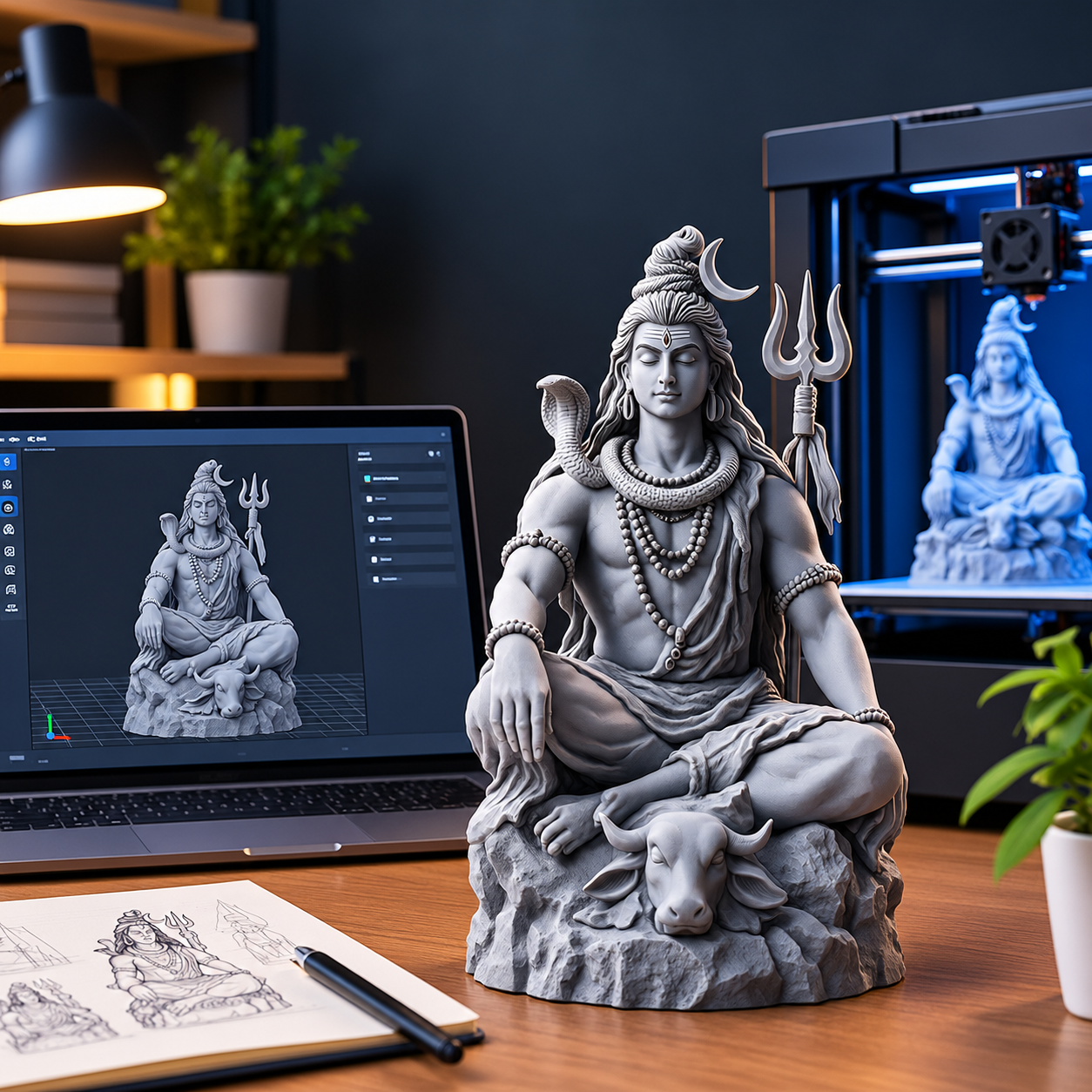
Many people opt for a Shiva statue as a collectible, home decor piece, or a gift. Therefore, a 3D printable file should have meaningful and culturally relevant details. Depending on a character’s pose and accessories, a Shiva statue can represent meditation, dance, destruction, creation, or other concepts. When choosing a 3D model for 3D printing, one should pay attention to the level of detail in details like the third eye, the character’s matted hair, the crescent moon, the snake, the trident, the damru, the mustache, and other elements.Moreover, potential buyers should look for 3D models with finely sculpted features, as they will look better on a printed statue. When in doubt, it is better to choose a safer, more detailed option with enough geometry to print at the desired scale.
Comparing Different Shiva 3D Models for Printing
When comparing different Shiva 3D models for printing, it is important to consider both visual and manufacturing-related factors. Statues with a similar visual appearance may have significantly different manufacturing requirements.
For example, one 3D printable file may only include a statue, while another one may have an additional base. Moreover, some 3D printable files only include separate parts, such as a character’s head. On the other hand, there are also multi-part 3D printable files, such as a statue with a removable headdress.One should also consider the desired surface finish quality. If one wants to hand-paint a 3D printed idol, they should choose a 3D model that has been created with this purpose in mind. Alternatively, if one wants a natural wood or stone print, the file’s geometry should also be compatible with these requirements.
Considering a Mahakal Shiva 3D Printable File with Extra Details
An ultra-detailed 3D model can be a good option for someone who wants a detailed Mahakal Shiva statue. However, one should always keep in mind that such a file may also include unnecessary details, extra geometry, or other issues. Moreover, the 3D printing process itself will impact the final print quality.Some file details, such as a character’s detailed hairstyle, may require extra supports. Very thin filaments or unnecessary geometry may also be incompatible with certain 3D printers.Before printing, it is a good idea to preview a potential 3D printable file in a preferred slicer and take a closer look at geometry. This way, one will see if there are any issues with the STL file, such as missing details, incorrect orientation, extra thin walls, and other problems.
Avoiding Common Shiva 3D Printing Mistakes
There are several common mistakes that one should avoid when 3D printing a Shiva statue. First of all, one should not get attracted to a 3D printable file’s pretty pictures and forget about the basic 3D printing requirements.
Other common mistakes include:
- Not taking a 3D model’s specifications and requirements into consideration
- Looking for excessively detailed models when a lower level of detail would suffice
- Printing at an unnecessarily large scale
- Forgetting to preview an STL file in a 3D slicer
- Using an incompatible 3D printing orientation
- Adding too many supports
- Skipping a 3D printing preview
- Forgetting about a model’s copyright or license
- Printing the entire model, as opposed to a smaller test print
Final Tips on Choosing the Best Model
When choosing the best 3D printable file, it is important to prioritize individual requirements. A small statue with intricate patterns and a larger one with moderate detailing will look different when printed. Therefore, it is important to keep the intended scale and printing technology in mind. During the research phase, one should take a closer look at a 3D model’s geometry, level of detail, base, supports, and file format. The right Mahakal Shiva 3D printable file will combine visual appeal with manufacturing-friendly geometry and will be compatible with the chosen 3D printer. After deciding on the intended scale and technology, one should spend some time comparing different 3D printable files. A careful approach will help one choose a 3D model that is compatible with their 3D printer and that has been created with the desired level of detail in mind.