2026-08-07 18:07:50
How to Choose the Right CNC Router Bits for Wood Carving
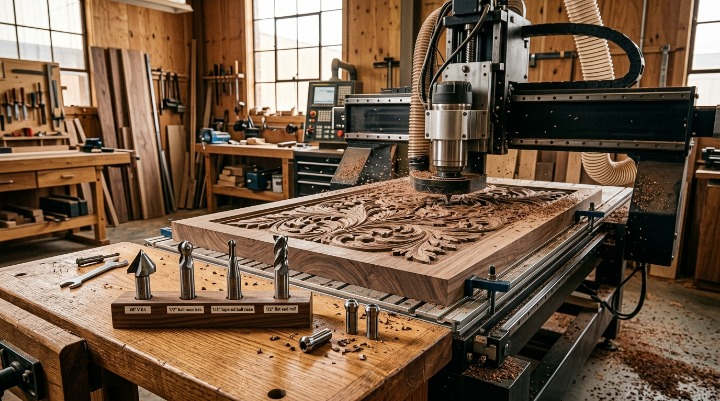
Selecting the appropriate CNC router bit is arguably one of the most crucial decisions you'll make in order to achieve smooth, clean and professional wood carving projects. Regardless of the quality of your CNC machinery and how professional your CNC designs, a poorly chosen router bit could result in a coarse surface finish, broken tools, unnecessarily long machining time or a lack of detail in the carving.
Whether you're a novice, a furniture maker, a CNC workshop owner or just a general woodworking enthusiast, having a good understanding of the various types of CNC router bits for wood carving can help you to significantly improve your woodworking projects and achieve better results out of every cut.
In this article, we'll outline the various types of common CNC router bits for woodworking. We'll discuss where each type is best used and the general considerations for choosing the right type for your woodworking project.
What Are CNC Router Bits?
CNC router bits are a specialized type of cutting tool designed to be fitted into the spindle of a CNC router. They spin at extremely high speeds and remove material from the wood, according to the instructions of the tool path that you have designed or downloaded.
The vast difference in shape, cutting angle, diameter and function of different bits is intended to help you achieve a vast range of outcomes. Some bits are manufactured for taking large material removals, whereas other router bits are designed for intricate details in engraving and 3D relief carving.
The appropriate choice of router bit is determined by a variety of factors, such as the type of wood being used, the desired depth of carve, how detailed the design needs to be, and indeed the parameters of your CNC machine and the finish desired.
Types of CNC Router Bits For Wood Carving
1. V-Bits
V-bits are perhaps the most common type of tool used in the carving of decorative designs and text for CNC engraving and decoration, They have a V shaped cutting tip and create grooves.
V-bits are commonly used for:
-
Text and lettering
-
Signs and name boards
-
Decorative patterns
-
Borders
-
Geometric designs
-
Detailed engraving
V-bits are available in a range of angles - such as 30, 60 and 90 degrees. The smaller the angle, the thinner and deeper the cut, whereas the wider cuts generated using the larger angle.
2. Ball Nose Bits
These router bits have a rounded cutting tip and are most commonly used in 3D wood carving on CNC machines.
Ball nose bits are ideally used when:
-
3D relief carving
-
Sculptural designs
-
Floral patterns
-
Human and animal figures
-
Decorative panels
-
Intricate artwork
They are widely considered to be a necessary addition to a CNC enthusiasts tool set for finishing passes as the rounded tip allows for the creation of smooth curves and surfaces on the carve.
3. Flat End Mills
Also called square-end bits, flat end mills have a flat cutting edge. They are one of the most used router bits for a wide range of applications, including pocketing and for removing material efficiently.
These router bits are often used for:
-
Pocketing
-
Roughing
-
Profile cutting
-
Flattening surfaces
-
Removing excess material
For many detailed carving projects a flat end mill is an ideal router bit to use for the roughing stage in order to remove the bulk of the excess material from the carve. This will then be followed up using a smaller router bit for fine details.
4. Tapered Ball Nose Bits
A hybrid of the ball nose bit and the tapered bit, tapered ball noses are particularly helpful for more detailed 3D carving work. The angled shaft allows the user to access more intricate part of the sculpt or carving design while retaining the smooth finish provided by the rounded cutting tip.
There are many factors to consider when you're selecting a router bit and the decisions can be made a lot easier by keeping a few key elements in mind;
Type of Wood
Each material has its own characteristics that necessitate the selection of specific bits and cutting parameters. Softwoods such as pine may carve easily with less tooling pressure required, where as hardwoods such as oak and maple will need stronger tools with appropriate cutting parameters. Materials such as MDF or plywood will benefit from specific tooling to prevent burning and to achieve good edge finishing.
Level of Detail
How intricate your CNC design will be will directly effect the type of router bit you select. For relatively large patterns or lettering a wider bit may be most appropriate and this will allow for faster machining. A very small ball nose or tapered ball nose is normally a better router bit for highly detailed relief carving.
Cutting Depth
Do not try and remove too much material in a single pass. For larger/deeper carvings, multiple passes are essential. Reducing the step down and step over can prevent undue stress being placed on the router bit and can lead to a better quality final finish.
Bit Diameter
The bit diameter will greatly effect the level of detail that can be achieved on a carve, but will also impact on the machining time. A larger bit is generally a faster option and will remove material quicker but cannot be used for minute details, whereas a small bit will capture all the fine details but will require far longer machining times. Multi-tool CNC projects, or those that involves a dual pass approach are therefore ideal.
Roughing vs Finishing Bits
If you wish to produce intricate carved finishes quickly and efficiently, then this multi-pass method is the best. Roughing can be achieved using large flat end mills or similar where you simply remove large amounts of the excess material from your carve. Finishing will then entail a fine detail bit of a ball or tapered ball nose nose to sculpt the finest curves to the intended detail. This technique can reduce machining time significantly over attempting to carve any detail using an extremely small bit.
Additional Tips for Better CNC Wood Carving
Here are a few basic but vital tips to help you get the best carving results out of your CNC router bits:
- Keep your router bits sharp and clean.
- Secure the wood firmly to the CNC bed.
- Use appropriate spindle speed and feed rate.
- Avoid excessive cutting depth per pass.
- Run a simulation before machining the final material.
- Use a suitable dust collection system.
- Test unfamiliar settings on scrap wood.
- Replace damaged or worn bits promptly.
A good understanding of your chosen router bits can also be coupled with good machine parameters which can lead to marked improvement of carved finishes.
Match CNC Bits With Quality CNC Designs
A high quality router bit will obviously perform better when its strengths are exploited with a quality CNC design. Even a high-quality cutting tool cannot be expected to produce fine results from poor quality models and tool paths, so ensuring a professional CNC file design is crucial.
Cadwala can help to provide you with precisely this; professional quality digital CNC designs which are perfect for wood carving projects, 3D relief work and everything in between. Created for woodworkers, furniture makers, CNC workshop owners and DIY CNC enthusiasts, our selection will allow you to convert your original concepts into physical objects more easily and more quickly. From simple decorative panels and carved ornaments for the furniture you craft to detailed 3D relief carving projects.
Final Summary
The selection of your CNC router bit when carving will depend heavily on the type of wood that you're using, the depth that you intend to carve at, how detailed your CNC design will actually be and the final desired surface finish. V-bits can carve details with impressive clarity as they leave V-shaped grooves within the wood. Ball nose bits are ideal for 3D carvings due to their naturally smooth finish, and flat end mills are best utilized when making the rough initial cuts through a larger volume of material.
If you need to achieve a fine finish and reduce your machining time, a two-pass approach, one for roughing then one for finishing, will provide a much more beneficial balance between material removal speed and the clarity of the finished surface.
Now that you have an understanding of the different types of CNC router bits for wood carving, you'll be much better equipped to select the ideal bit for each project that you create. The result will be cleaner CNC woodworking and better quality finishes on your designs.
Cadwala can provide you with ready to use designs to help to complement your choice of CNC router bit and to really take your CNC carving to the next level.